

The image above shows a simple ankle range-of-motion test we use all the time at ASR. The test is a simple but powerful way to assess ankle dorsiflexion (keep this big word in your lexicon to impress your friends), which is the ability of the knee to move forward over the foot while the heel stays planted on the ground. Not being able to do this may seem inconsequential, but this tiny movement plays a major role in how the entire lower body functions.
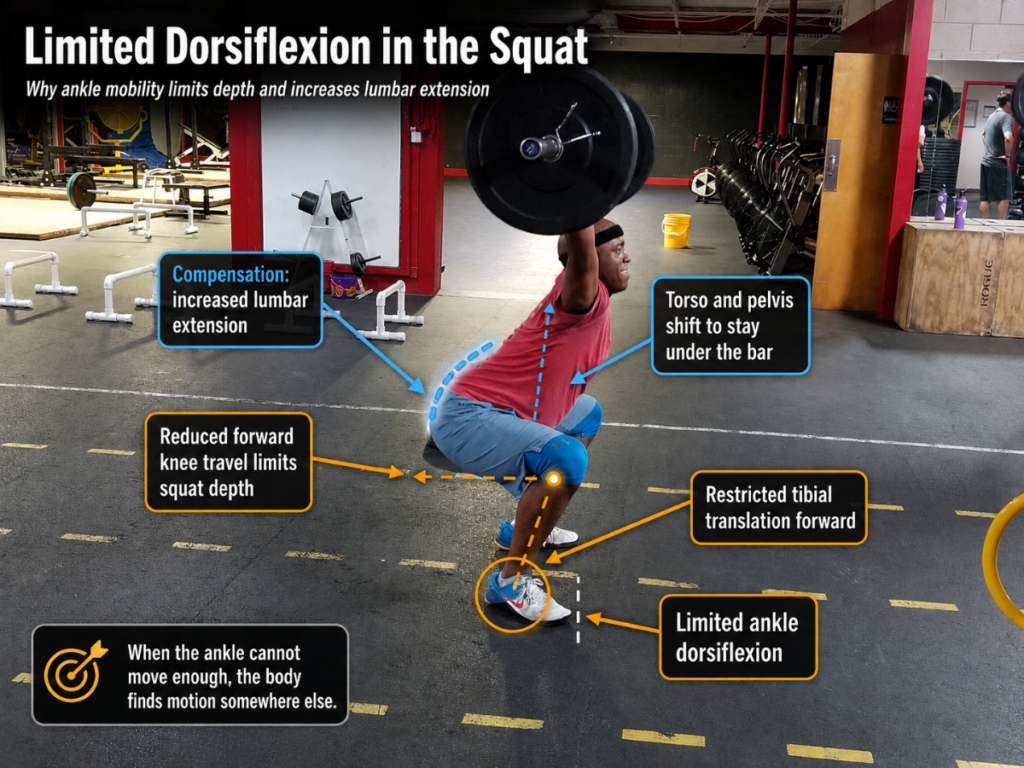
Good ankle range of motion is essential for squatting, lunging, running, jumping, cutting, swinging a golf club or baseball bat and absorbing force during athletic movement. When the ankle does not function as an ankle, the body usually finds motion elsewhere. Common compensations are the foot collapsing inward, the knee diving toward the midline, the heel lifting, or the hips and trunk shifting to get around the restriction.
During the test, the athlete places one foot 5 inches from a wall and drives the knee forward toward the wall while keeping the heel flat on the floor and the foot stable. Ideally, the knee tracks over the second or third toe without the arch collapsing or the body or hip twisting. This gives us a quick look at whether the ankle has the mobility and control needed for efficient movement.
Limited ankle dorsiflexion can contribute to poor squat depth, excessive pronation, knee valgus, Achilles tendon pain, plantar fasciitis, and increased demand on the knee, hip, or low back, which can also result in pain. Identifying these limitations early allows us to target the right combination of mobility work, soft tissue treatment, strengthening, and movement retraining.
In simple terms, this test helps us determine whether the ankle is working as it’s supposed to, so the rest of the body doesn’t have to compensate.
Your homework this week is to take 30 seconds to complete this simple test. If you don’t pass, CONGRATS, you have successfully identified something you can easily fix with corrective exercises and prevent an injury.